
Budgeting
How to Cut Your Grocery Bill by 30%: Realistic Ways to Save Money on Groceries in 2026
By Anil Choudhary · Updated August 16, 2026 · Reviewed August 16, 2026 · 15 min read
Quick Answer
Cutting a grocery bill by 30% usually means combining store-brand swaps, a simple weekly meal plan, unit-price comparisons, and less food waste, not eating less. Most households see 10-20% within weeks, with 25-30% realistic over a couple of months. Use the calculators below to find your own number.
Key Takeaways
- •Store-brand swaps, meal planning, and unit pricing together typically cut 10-20% off a grocery bill within weeks.
- •A full 30% reduction is possible but usually requires stacking several habits over a couple of months, not one big change.
- •Food waste and impulse buys quietly account for a large share of most grocery bills, cutting them costs nothing.
- •Five free calculators on this page let you run your own household numbers instead of relying on averages.
- •USDA Food Plan benchmarks are a useful reference point for what a "normal" grocery budget looks like by family size.

The total at checkout has a way of catching you off guard. Nothing in the cart felt unusual, nothing on the list seemed extravagant, and yet the number is ten or twenty dollars higher than expected. If that's happened to you more than once this year, you're not imagining it. Food prices have climbed steadily since 2022, and for a lot of households, paychecks haven't kept pace.
The first instinct is usually to start cutting things you actually like, smaller cart, skip the brand you prefer, put the treats back. That works for a week or two, then it stops feeling sustainable and the old habits creep back in. A better approach is finding the handful of changes that actually move the number without turning every trip to the store into an argument with yourself.
That's what this guide is about. Five free calculators are built into it, so instead of taking anyone's word for what's possible, you can run your own numbers and see what a realistic reduction actually looks like for your household.
What Is the Fastest Way to Cut Your Grocery Bill?
The fastest way to cut a grocery bill is to shop from a list built around a short meal plan, switch two or three staples to store brands, and compare unit prices instead of shelf prices. Combined, these three habits typically cut 10-20% off a monthly food budget within the first few weeks.
Why Groceries Feel Like They're Eating a Bigger Chunk of the Paycheck
Part of this isn't really about groceries at all, it's that everything else gets paid first, and groceries are just where the squeeze finally shows up.
Rent, gas, and insurance already claimed the money
Rent or the mortgage comes out first, usually on autopay. Utilities and insurance follow. Then whatever it costs to actually get to work. Groceries end up competing with debt payments for whatever's left, so by the time you're in the checkout line, there isn't much cushion left to absorb a bill that runs higher than planned.
You're probably already improvising
Reading price tags twice. Putting something back at the register. Grabbing the smaller size without really thinking about it. If that's your normal, the issue usually isn't that you're bad at shopping, it's that these reflexes don't add up to much on their own. A few specific, repeatable habits do more than constant on-the-spot decisions.
The small stuff is the sneaky part
A five-dollar item here, an eight-dollar add-on there, none of it feels like a big deal in the moment. But a few of those on every trip, multiplied across a month, is usually bigger than people guess until they actually add it up.
Credit cards make it easy to lose track
Putting groceries on a card isn't the problem by itself, plenty of people do it and pay it off every month. It becomes a problem when the balance carries over and starts collecting interest. The fix isn't swearing off credit cards; it's spending less at the register in the first place, so there's less riding on the balance either way.
None of this needs to be fixed in one week. A handful of specific changes, kept up consistently, tend to beat one dramatic overhaul that fizzles out by the second month.
Case Study: A Family of Four in Austin, Texas
Groceries for this household, two adults, two kids under 12, averaged $980 a month before any changes, tracked over six weeks using receipts and a simple spreadsheet. They started with three of the habits covered in this guide: switching about a dozen recurring items to store brands, building a loose weekly meal plan around two or three proteins, and freezing bread and meat before it had a chance to spoil.
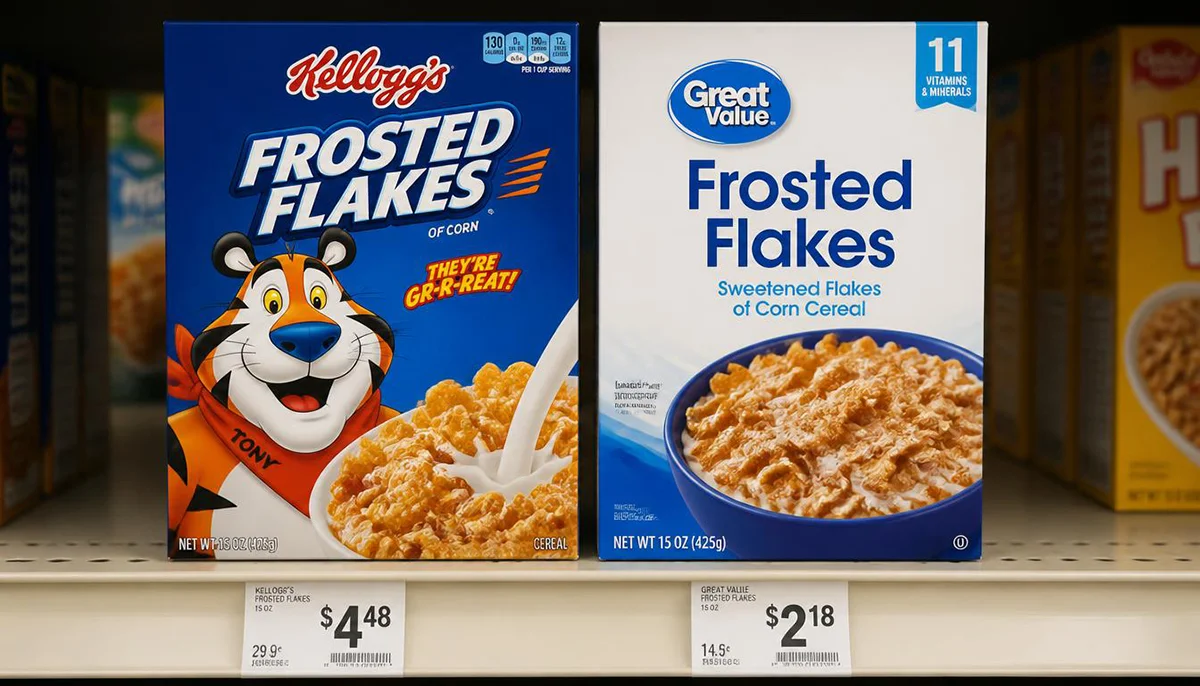
Nothing dramatic changed in what they ate. The kids still got the cereal they liked, just the store-brand version after a side-by-side taste test at home. Grocery trips went from three or four a week down to one planned trip, plus an occasional top-up.
After two months, their average monthly spend settled at $812, a $168 reduction, or about 17%. Store brands accounted for roughly $70 of that; meal planning and less waste made up most of the rest. They didn't hit the full 30% target, and didn't try to. A steady 17% that actually stuck mattered more than a stretch goal that wouldn't.
The Big Idea: Small Changes Add Up
You don't need to become an extreme couponer or cut out food you actually enjoy. A handful of repeatable habits, store brands on a few staples, a loose meal plan, checking unit prices instead of shelf tags, trimming food waste, catching impulse buys before they hit the cart, add up faster than people expect. How much depends on your household, income, and location, so every number below is an example to work from, not a promise. The calculators are there so you can plug in your own numbers instead of mine.
Calculator: Item Swap Savings Calculator
Start with one specific swap, a product you buy regularly where a cheaper alternative exists. Enter the numbers below and see what that single swap is worth over a year.
Annual Savings
$0.00
Calculator: How Much Could I Save on Groceries?
This one works from your total monthly grocery spending. Enter your number, then try a few reduction targets to see what each one is actually worth.
Target reduction
Estimated Monthly Savings
$0.00
Where Your Grocery Money May Be Going
Before deciding where to cut, it helps to see roughly where a typical grocery budget gets spent. The table below is an illustrative breakdown of a $900 monthly grocery budget, adjust the categories to match your own household, since every family's mix looks different.
| Category | Share of Budget | Illustrative Monthly Amount |
|---|---|---|
| Meat & protein | 25% | $225 |
| Produce | 18% | $162 |
| Dairy | 12% | $108 |
| Pantry staples | 15% | $135 |
| Snacks | 10% | $90 |
| Drinks | 8% | $72 |
| Convenience food | 7% | $63 |
| Household items | 5% | $45 |
Strategy: Store Brands
Generic and private-label products, the store's own version of cereal, pasta, canned goods, cleaning supplies, paper towels, usually cost less than the name-brand equivalent. The gap isn't consistent across products, so compare a few staples you actually buy instead of assuming one fixed percentage applies everywhere. Cereal, pasta, canned beans, peanut butter, and laundry detergent tend to be the easiest starting points, since the ingredients on the store-brand version are often nearly identical.
Calculator: Brand vs Store Brand Savings Calculator
Cheapest doesn't automatically mean best, check the unit price, package size, and ingredient list before switching anything. But when a store brand really does match what you're used to, here's what the swap is worth over a year.
Annual Savings
$0.00
A few illustrative brand vs. store-brand examples
| Product Category | Example Name-Brand | Example Store-Brand | Example Difference | Example Saving % |
|---|---|---|---|---|
| Cereal | $4.99 | $2.99 | $2.00 | 40% |
| Pasta | $2.29 | $1.19 | $1.10 | 48% |
| Peanut butter | $4.49 | $2.79 | $1.70 | 38% |
| Laundry detergent | $12.99 | $8.49 | $4.50 | 35% |
| Canned beans | $1.49 | $0.89 | $0.60 | 40% |
No single brand is always cheaper everywhere, compare unit price at your own store before switching.
Strategy: Meal Planning
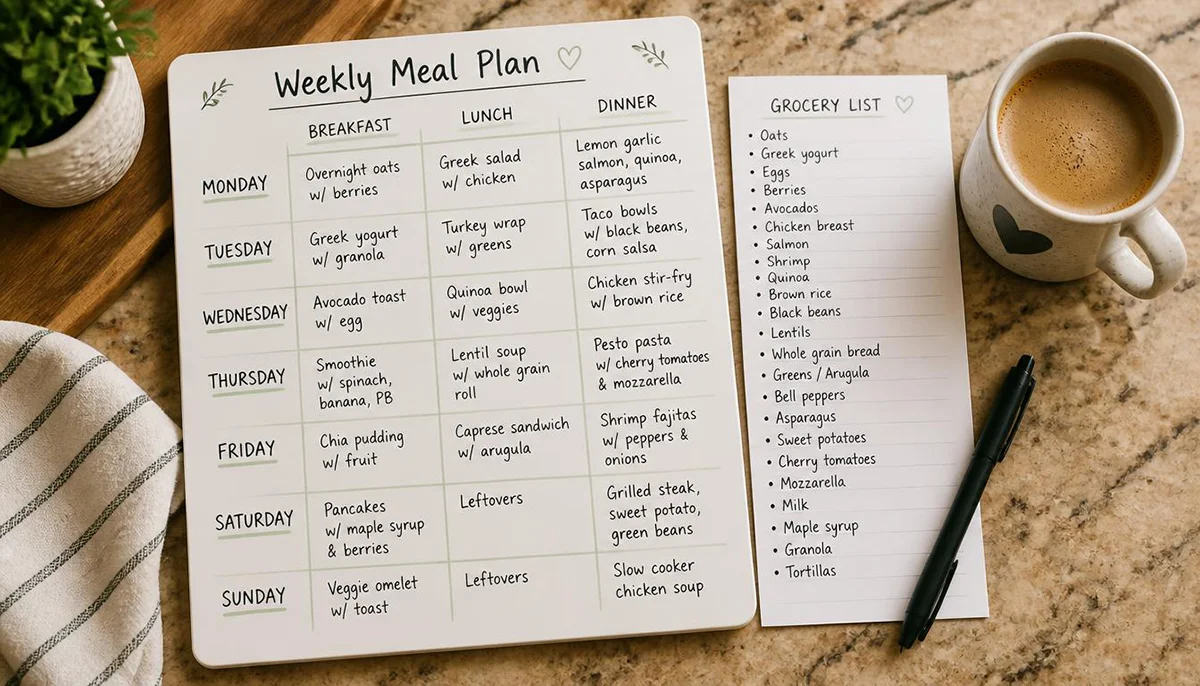
Meal planning doesn't have to mean a color-coded spreadsheet. A five-minute pantry check before you shop, paired with a loose idea of the week's meals, cuts down on both wasted ingredients and last-minute takeout more than most people expect. Pick meals that share ingredients so nothing sits unused in the fridge. Cook a bit extra on purpose so leftovers become tomorrow's lunch instead of tonight's waste. And use the freezer, bread, meat, and even some cooked meals hold up fine frozen, which buys time before anything spoils.
A rough seven-day version: pick two or three proteins for the week, build meals around them with overlapping vegetables and a shared starch (rice, pasta, potatoes), plan one leftovers night, and leave the last meal open for whatever's still in the fridge by day six or seven.
Turn that plan into a cheap grocery list before you leave the house, write down exactly what each meal needs, check it against what's already in the pantry, and cross off anything you're buying out of habit rather than need. A short grocery shopping checklist tied to the week's meals is one of the simplest ways to keep a trip from ballooning past what you planned to spend.
Strategy: Unit Pricing
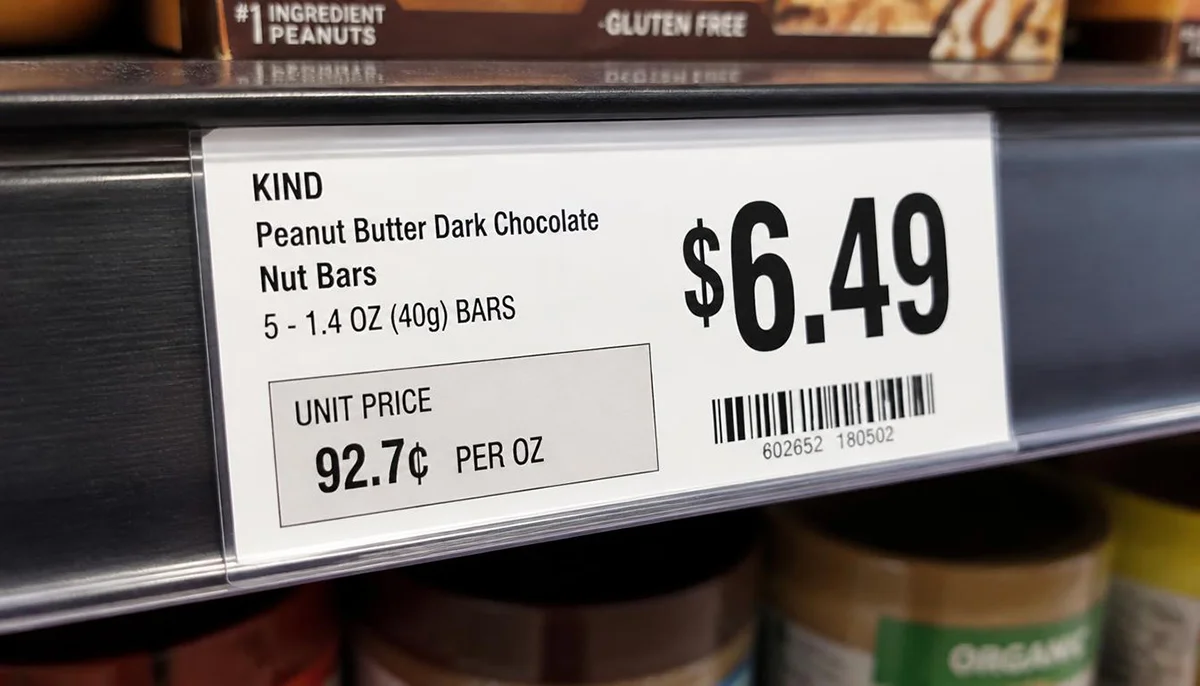
Package size can make a "sale" look cheaper than it actually is. A bigger box at a lower shelf price isn't automatically the better deal, the only comparison that actually tells you anything is price per ounce, per pound, or per 100 grams. Most stores print that number on the shelf tag in tiny type. Glance at it before assuming the larger package wins.
Calculator: Unit Price Calculator
Enter a product's price and package size to see the true price per unit, useful for comparing two sizes of the same product, or two different brands side by side.
Unit Price
$0.00
This calculator provides estimates based on the numbers you enter.
Strategy: Coupons and Loyalty Programs
Real savings tools are worth using as long as they line up with what you'd buy anyway: the Walmart app, Kroger digital coupons, Target Circle, Costco promotions, Aldi's weekly deals, and most major supermarket loyalty programs offer genuine, no-catch discounts. Cashback apps can add a little on top. Watch for the one trap, though, buying something purely because it's discounted. A coupon doesn't save money if it talks you into a purchase you wouldn't have made otherwise.
Strategy: Reducing Food Waste
Unused food is spent money, full stop. A few habits make a real dent here: freeze bread and meat before they're at risk of spoiling, turn leftover vegetables into soup or stew instead of letting them wilt, plan intentional leftovers rather than treating them as an afterthought, and store produce properly so it actually lasts as long as it's supposed to.
Strategy: Bulk Buying, When It Helps and When It Doesn't
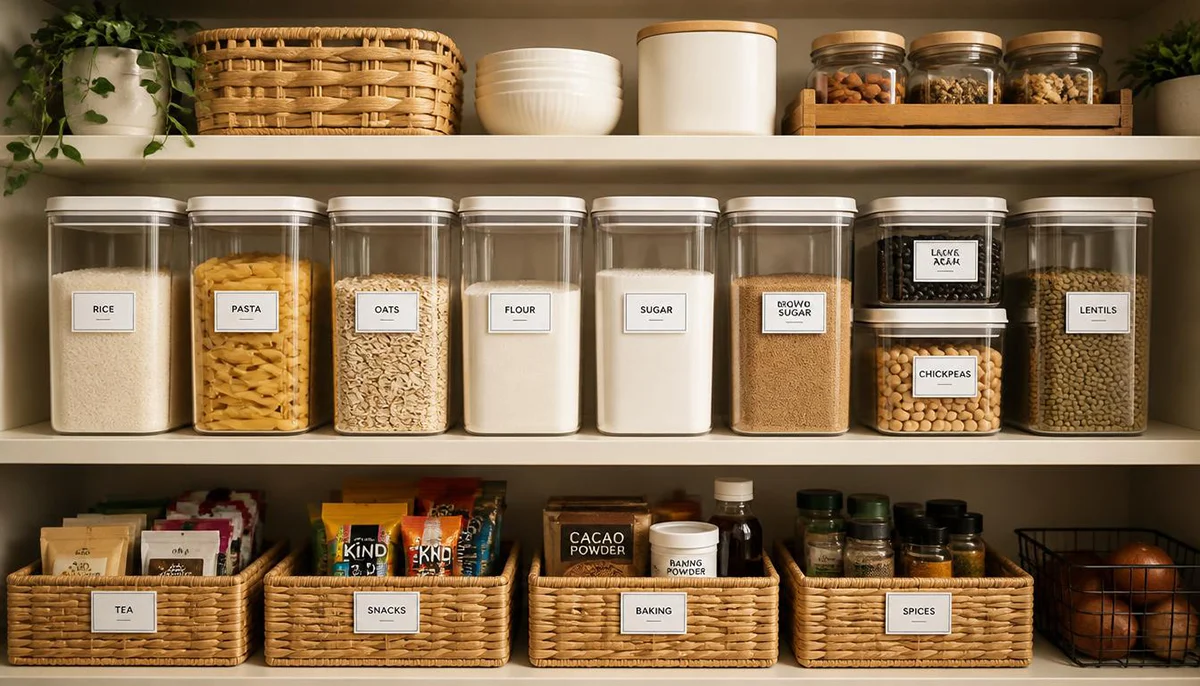
Bulk buying makes sense when an item has a long shelf life, your household uses it regularly, and the unit price is meaningfully lower than the smaller size. It doesn't make sense for perishables you can't finish in time, items your family rarely uses, or anything you're only buying because it happens to be on sale that week. A great unit price on food that ends up thrown out isn't a saving at all.
Strategy: Catching Impulse Purchases
End-cap displays, checkout-lane items, "2 for $X" deals, and oversized "value" packages are designed to catch your eye right when you're least likely to think it through. One honest question cuts through most of it: would I buy this if it weren't on sale? If not, put it back. Shopping on a full stomach helps too, nothing scientific about it, hunger just makes a list a lot easier to ignore.
Strategy: Comparing Stores
There's no single winner among the cheapest grocery stores, different chains tend to be cheaper on different categories. Aldi and Walmart often come out ahead on pantry staples and packaged goods, warehouse clubs like Costco can win on bulk items your household actually uses, and regional grocers sometimes beat the national chains on produce or meat. Notice which type of store consistently wins on what your household buys most, rather than assuming one retailer beats every other on everything.
Aldi vs Walmart Grocery Prices
Aldi and Walmart come up constantly in this comparison because they're both built around low prices, just through different models. Aldi keeps costs down with a smaller store footprint, a limited assortment of mostly private-label products, and fewer staff, savings that get passed straight through to shelf prices. On a basket of core staples (milk, eggs, bread, produce, pantry basics), Aldi is frequently a few percent cheaper than Walmart, and sometimes more, because there's less overhead and less brand markup baked into each item.
Walmart's advantage is breadth. It carries name brands Aldi simply doesn't stock, runs a much wider produce and meat selection, and layers in rollback pricing and its own store brand (Great Value) that can match Aldi on many of the same items. If your list is heavy on national brands, specialty items, or one-stop convenience, household goods, pharmacy, electronics, Walmart usually wins on total trip value even if a few individual grocery items ring up higher.
In practice, most households don't need to pick one permanently. A common pattern that works: do the bulk of a weekly staples run at Aldi where the private-label overlap is highest, then fill in name-brand items, produce, or anything Aldi doesn't carry at Walmart. Run a few identical items through the Unit Price Calculator above at each store to see which one is actually winning on the products your household buys most, the answer varies more by region and specific item than most price-comparison articles admit.
One more difference worth knowing: Aldi charges a small refundable deposit for shopping carts and expects you to bag your own groceries, which is part of how it keeps labor costs, and prices, down. Walmart offers full-service checkout, self-checkout, and pickup or delivery, which costs more to run but adds convenience Aldi doesn't offer. If your time is worth more than the price gap, that convenience can outweigh the savings on any given trip.
Cheapest Grocery Stores in America
No single chain is the cheapest grocery store in America across every category, but a handful consistently show up near the bottom of price-comparison studies. Aldi and Lidl (where available) lead on private-label staples thanks to their limited-assortment model. WinCo, a employee-owned chain concentrated in the West and Midwest, is frequently priced below both Walmart and Aldi in markets where it operates, partly because it skips traditional advertising. Walmart remains the broadest low-price option nationally, especially for households that want one store for everything. Warehouse clubs, Costco and Sam's Club, can beat all of the above on a per-unit basis for bulk staples, but only if your household actually uses the larger quantities before they spoil, and only after factoring in the membership fee.
Trader Joe's is worth a mention too: it isn't marketed as a discount chain, but its private-label pricing on specific categories (snacks, frozen items, wine) often undercuts traditional grocers. The honest takeaway is that "cheapest" depends on your zip code, which of these chains are actually nearby, and which categories you buy the most of, a store that's unbeatable on pantry staples might be average on meat and produce. Comparing a handful of your regular items across the two or three closest options, once, tells you more than any national ranking.
If none of these chains operate near you, the same logic still applies: look for limited-assortment or regional discount grocers rather than assuming the biggest national name is automatically the cheapest. A store with a smaller footprint and less advertising almost always has more room to compete on price than a full-service supermarket carrying every brand.
Calculator: What If I Change 5 Grocery Habits?
Instead of adding percentages together, which tends to overstate the result when savings overlap, estimate a realistic monthly dollar saving for each habit below and let the totals speak for themselves.
Estimated Monthly Savings
$0.00
These figures overlap in real life and are added directly as dollar estimates rather than combined percentages, to avoid overstating your total.
The 30% Plan: A Realistic Hypothetical
Thirty percent is a target, not a guarantee. Here's roughly what it could look like in practice for a household spending $900 a month, built from a handful of smaller changes rather than one dramatic swap:
| Illustrative Improvement | Estimated Monthly Saving |
|---|---|
| Store-brand substitutions | $60 |
| Meal planning | $45 |
| Food-waste reduction | $30 |
| Impulse-purchase reduction | $45 |
| Coupons / loyalty programs | $20 |
| Total illustrative improvement | $200 (≈22%) |
Getting closer to a full 30% ($270) usually means combining several habits consistently over multiple months, not making one single change.
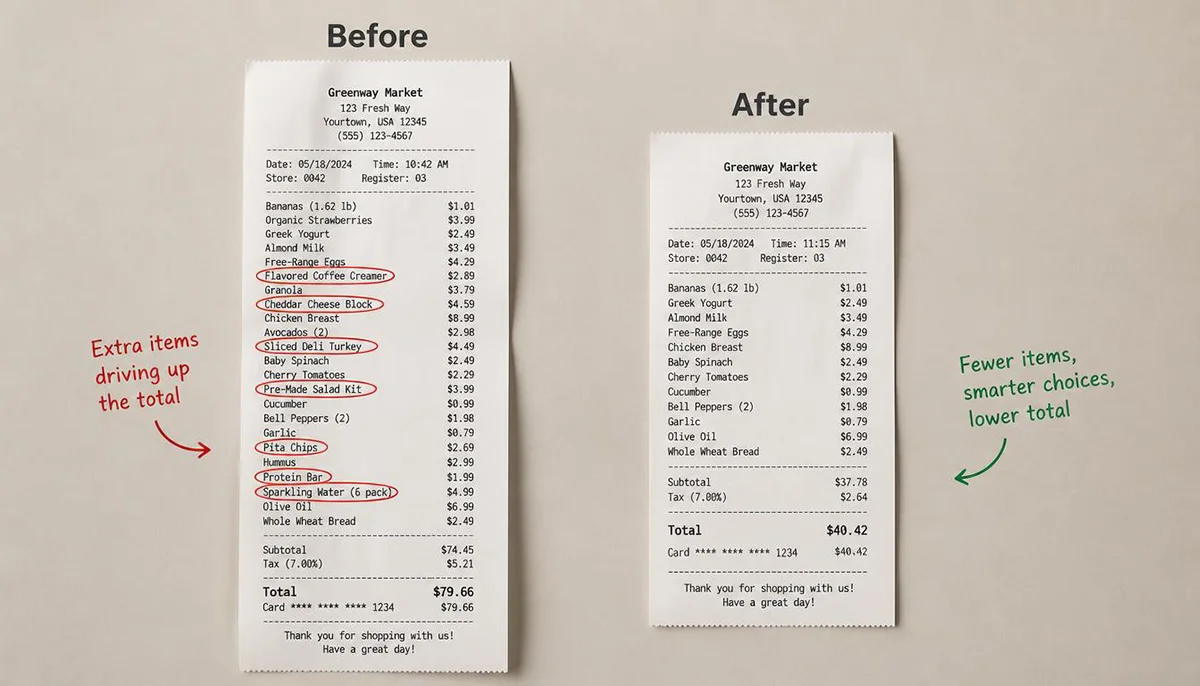
Before vs. After: Two Shopping Scenarios
Scenario A, No Planning
A grocery trip with no list, a handful of impulse purchases at the end-caps and checkout, a few ingredients that never get used before they spoil, and a couple of convenience meals grabbed on the way out. Nothing about this trip is unreasonable, it's just how shopping tends to go without a plan.
Scenario B, Planned Shopping
A quick pantry check before leaving, a loose meal plan for the week, a written list, a glance at unit prices instead of shelf tags, one or two store-brand substitutions, and leftovers frozen instead of tossed. Same store, roughly the same list of things the household actually needs, just a different process for getting there.
The illustrative difference between these two approaches often lands somewhere in the $30-$80 range per shopping trip, depending on household size and how much impulse buying Scenario A included. Over a month of weekly trips, that's a meaningful number, but it's an example, not a promise of what your own trips will look like.
You Don't Need to Fix Your Whole Financial Life This Week
You don't have to give up food you actually enjoy, become an extreme couponer, or spend an hour comparing every item on the shelf to see a real difference. Start with one habit, switching two or three staples to store brands this week is usually the easiest place to begin. Once that feels normal, add a second: a loose meal plan, or actually checking unit prices instead of the shelf price. A third change comes easier once the first two are routine. Small changes stacked over a couple of months tend to outlast a strict overhaul that gets abandoned by week three.
If You Only Do 5 Things…
- Make a grocery list before you shop.
- Compare unit prices, not shelf prices.
- Try store brands on two or three staples.
- Plan meals around what you already have.
- Track your grocery spending for 30 days.
The 30-Day Grocery Reset
A simple, low-pressure way to find your own numbers over the next month:
Week 1, Track. Keep every grocery receipt or note every purchase. Don't change anything yet, just see where the money is actually going.
Week 2, Trim. Look back at week one and remove the purchases that clearly weren't planned or needed. No judgment, just notice the pattern.
Week 3, Test. Swap two or three regular items to store-brand alternatives and see how they compare on taste and quality, not just price.
Week 4, Review. Compare your total spend across the four weeks. Use the calculators above to turn that difference into a monthly and annual figure.
From a Weekly Habit to a Yearly Number
Small weekly savings sound modest until they're annualized. The table below shows how a handful of common weekly savings amounts turn into monthly and yearly totals, using weekly × 52 ÷ 12 for the monthly estimate.
| Weekly Saving | Approx. Monthly | Annual |
|---|---|---|
| $5 | $21.67 | $260 |
| $10 | $43.33 | $520 |
| $20 | $86.67 | $1,040 |
| $30 | $130.00 | $1,560 |
| $40 | $173.33 | $2,080 |
| $50 | $216.67 | $2,600 |
Monthly Grocery Savings by Spending Level
A quick reference for what different reduction percentages are worth at a few common monthly grocery budgets.
| Current Monthly Spend | 5% | 10% | 15% | 20% | 25% | 30% |
|---|---|---|---|---|---|---|
| $500 | $25 | $50 | $75 | $100 | $125 | $150 |
| $700 | $35 | $70 | $105 | $140 | $175 | $210 |
| $900 | $45 | $90 | $135 | $180 | $225 | $270 |
| $1,100 | $55 | $110 | $165 | $220 | $275 | $330 |
| $1,300 | $65 | $130 | $195 | $260 | $325 | $390 |
Don't see your own monthly spending here? Use the "How Much Could I Save on Groceries?" calculator above to run your exact number.
Average Grocery Budget by Family Size (USDA-Based)
How much should groceries cost per month? It depends heavily on who's eating, but the USDA grocery budget 2026 update gives you a workable range instead of a guess. The table below uses the Low-Cost to Moderate-Cost tiers as a realistic monthly food budget for most households.
| Family Size | Monthly Budget |
|---|---|
| 1 Adult | $300-$450 |
| 2 Adults | $550-$750 |
| Family of 3 | $700-$900 |
| Family of 4 | $850-$1,100 |
Based on USDA Food Plan ranges (Low-Cost to Moderate-Cost tiers). The average grocery bill for family of 4 households usually falls in the $850-$1,100 range, though location, ages, and diet shift that number in either direction.
Grocery Budget by State: California, Texas & Florida
The USDA Food Plans set a national baseline, but where you actually shop shifts the number, sometimes by a lot. The ranges below adjust the national family-of-four baseline for regional cost-of-living differences; they're estimates to plan around, not official state-level USDA figures, since actual grocery costs vary by city, store, and household diet.
Grocery Budget: California
California generally sits above the national average, driven mostly by higher costs in coastal metros like Los Angeles, San Francisco, and San Diego, inland cities such as Fresno or Bakersfield run noticeably closer to the national baseline. A family of four in a California metro area should reasonably plan for $1,000-$1,400 a month, versus the $850-$1,100 national range. The store-comparison habit matters more here than almost anywhere else: Aldi, WinCo (where available), and Grocery Outlet locations tend to undercut coastal supermarket chains by a wide margin on the same staples. If you're budgeting for a California household, start from the higher end of the national range rather than the midpoint, then use the family grocery budget calculator above to fine-tune it against your actual city and household size. Even within the state, the gap between a coastal metro and an inland city can be $150-$250 a month, so a statewide average is only a starting point for your own planning.
Grocery Budget: Texas
Texas tracks close to the national average overall, with grocery costs in major metros, Houston, Dallas, Austin, San Antonio, typically landing near or just above the USDA baseline. A family of four should plan for roughly $850-$1,150 a month, with H-E-B (a regional chain known for competitive pricing) often serving as the price benchmark other Texas grocers get compared against. Austin runs a bit higher than the rest of the state due to overall cost-of-living pressure, while smaller Texas cities and rural areas often land below the state average. No state sales tax on most grocery items also helps Texas households a little compared to states that tax food purchases, though it's a modest effect next to where you actually shop. Given the state's size, comparing your own spending against the Texas metro closest to you will tell you more than the statewide range alone.
Grocery Budget: Florida
Florida sits close to the national average as a state, but with real variation between tourist-heavy metros and the rest of the state. Miami and other South Florida markets run higher, a family of four there might see $950-$1,300 a month, while central and north Florida markets are often closer to the $850-$1,100 national range. Publix dominates the Florida grocery landscape and isn't the cheapest option on every item, so pairing it with Aldi or Walmart for staples is a common way Florida households bring their average down. Like Texas, Florida doesn't apply sales tax to most grocery items, which helps a little at checkout regardless of which store you choose. Seasonal population swings in tourist-heavy areas can also nudge prices up during peak travel months, so a South Florida household's summer grocery bill may run a bit lower than its winter one.
A Note on Sources
If you want an outside benchmark for a reasonable grocery budget, the USDA Food Plans publish updated monthly benchmarks (Thrifty, Low-Cost, Moderate, and Liberal) broken out by age and family size. For the bigger picture on food inflation, the Bureau of Labor Statistics' Food CPI data tracks how grocery prices are moving nationally, category by category. Treat both as reference points, not a target you've failed to hit if your own number looks different.
Calculate Your Exact Grocery Budget
The numbers in this guide are a starting point, not your household's actual budget. Use the grocery budget planner above for a personalized monthly target, then run the numbers through the rest of our tools: the Percentage Calculator to work out exactly what a 10% or 20% cut is worth, and the Discount Calculator to check whether a "deal" is actually a deal before it goes in the cart.
If rising prices are the bigger worry, the Inflation Calculator works as a simple food budget planner, it shows how much your grocery budget needs to grow each year just to keep up.
This article is for general information and isn't financial, medical, or legal advice. Every dollar figure and percentage above is an illustrative example, not a guarantee, actual prices and results vary by store, location, and household. Check current prices at your own store before making a purchasing decision.
Editorial Policy
This article is reviewed for factual accuracy and updated using publicly available USDA Food Plan and U.S. Bureau of Labor Statistics data.
Last reviewed: August 16, 2026 · Next scheduled review: February 2027