
Salary & HR
How Is Overtime Pay Calculated in the USA?
By Anil Choudhary · Updated August 2026 · 8 min read
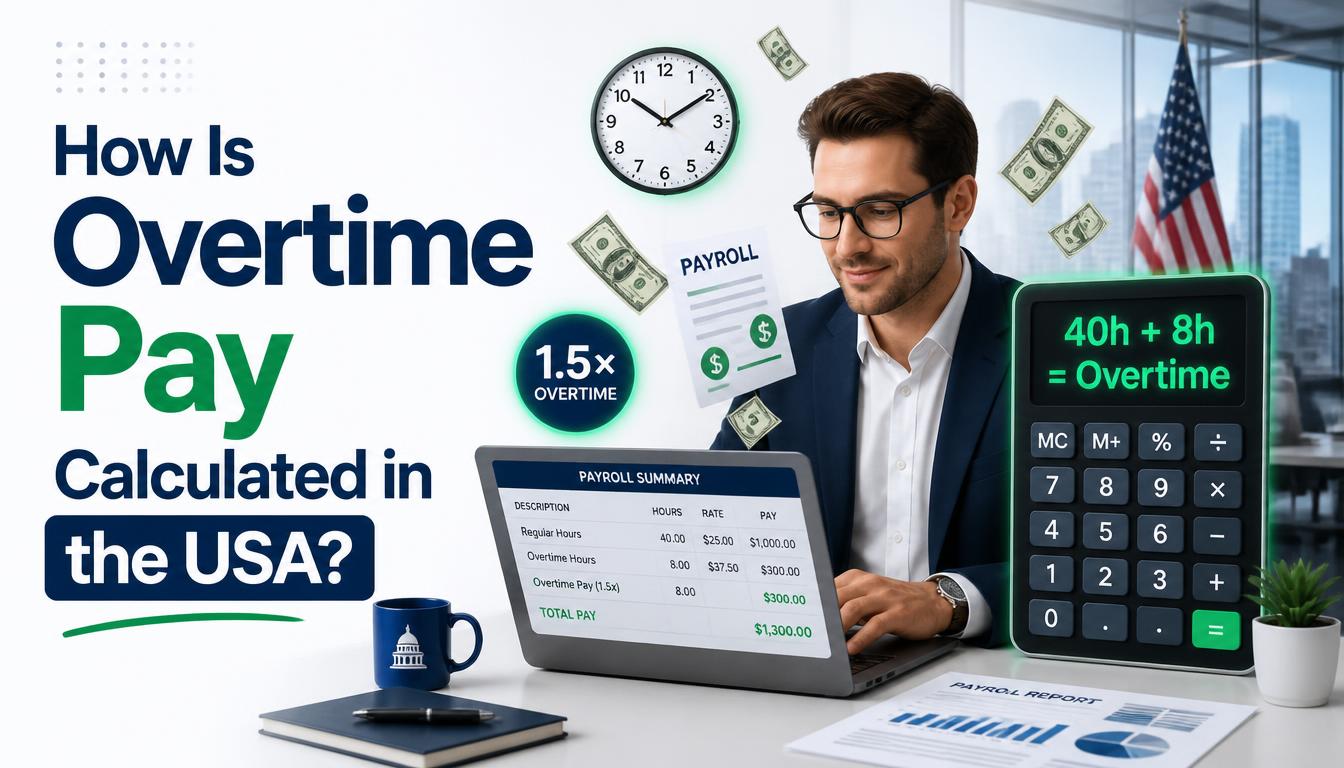
If you've ever squinted at a paycheck trying to figure out whether your overtime hours actually got paid right, you're not alone. The math itself isn't complicated once you know the rule — the confusing part is usually figuring out which rule applies to you in the first place, since federal law, state law, and your employer's own policy can all be in play at once.
Here's the short version: under federal law, if you're a covered, nonexempt employee, you're entitled to at least 1.5 times your regular rate for every hour you work beyond 40 in a single workweek. Everything else on this page is really just explaining the pieces of that one sentence.
The 40-Hour Rule, and What "Workweek" Actually Means
The Fair Labor Standards Act (FLSA) sets the federal baseline: overtime applies to hours worked over 40 in a workweek. A workweek isn't the same thing as a calendar week or your pay period — it's a fixed, recurring block of 168 consecutive hours (seven 24-hour days) that your employer defines and can't change on a whim to dodge overtime. It doesn't have to start on a Monday. Some employers run it Sunday to Saturday, others Wednesday to Tuesday — whatever it is, it has to stay consistent.
This matters more than it sounds like it should, because it means your pay period doesn't determine your overtime. If you're paid biweekly, each of the two workweeks inside that pay period is evaluated on its own. Work 45 hours one week and 35 the next, and you're still owed 5 hours of overtime for the first week — even though your two-week total lands at a tidy 80 hours that might look "even" on paper.
Who's Actually Covered
Overtime protection under the FLSA applies to covered, nonexempt employees. Most hourly workers fall into this bucket automatically. Salaried employees can too — being salaried doesn't, by itself, make someone exempt. Exemption depends on meeting both a minimum salary level and a specific duties test tied to executive, administrative, professional, or a few other defined categories. If you want the full breakdown of exempt vs. nonexempt, including where the actual legal lines sit, we cover that in more depth in Salaried vs Hourly Employees: Who Gets Overtime?
Regular Rate vs. Hourly Rate
For most hourly workers, your regular rate and your hourly rate are the same number, and the calculation stays simple. But the FLSA's definition of "regular rate" is technically broader than just your posted hourly wage — nondiscretionary bonuses, commissions, and certain shift differentials generally have to be folded into the regular rate before the overtime multiplier gets applied. If your pay includes anything beyond a flat hourly wage, the real regular rate can end up a little higher than your base rate suggests, which means your overtime pay should be too.
The Overtime Formula
Regular Hours = MIN(Total Hours, 40)
Overtime Hours = MAX(Total Hours − 40, 0)
Overtime Rate = Regular Rate × 1.5
Total Pay = (Regular Hours × Regular Rate) + (Overtime Hours × Overtime Rate)
That's the whole thing. Everything from here is just plugging numbers into that formula and sanity-checking the result.
Three Worked Examples
Numbers land better with actual examples, so here are three at different pay rates and hour totals.
$20/hour, 45 hours worked
40 regular hours × $20 = $800. The remaining 5 hours are overtime at $30/hour (1.5 × $20), adding $150. Total for the week: $950.
$25/hour, 48 hours worked
40 regular hours × $25 = $1,000. The remaining 8 hours are overtime at $37.50/hour, adding $300. Total for the week: $1,300.
$30/hour, 50 hours worked
40 regular hours × $30 = $1,200. The remaining 10 hours are overtime at $45/hour, adding $450. Total for the week: $1,650.
Notice the pattern: the overtime hours are worth 50% more per hour than the regular hours, and that premium compounds fast the more hours you put in past 40. Ten hours of overtime at $30/hour isn't $300 — it's $450, purely because of the multiplier.
Under 40, Exactly 40, and Over 40
Below 40 hours, you're paid your regular rate for every hour worked and no overtime applies, full stop — even if it's 39.5 hours. At exactly 40 hours, same thing: you're paid your regular rate across the board, and overtime hasn't kicked in yet. It's only once you cross 40 — 40.01 hours and up — that any additional time earns the 1.5x premium. A lot of people assume overtime starts "around" 40 hours in some fuzzy sense; it doesn't. It's a hard line.
Does Weekend or Holiday Work Count as Overtime?
Not automatically. Federal overtime doesn't care which days you worked — only how many total hours landed in the workweek. Working Saturday and Sunday doesn't trigger overtime pay by itself; it's just two more days of hours added to your weekly total, treated exactly like any weekday hours. Same goes for holidays — the FLSA doesn't require any special holiday premium. If your paycheck has ever bumped up on a holiday, that's a benefit your employer chose to offer, not a federal requirement.
Where State Law Changes the Math
Federal law is the floor, not the ceiling, and several states layer additional protections on top. California is the one most people have heard of — it generally requires overtime after 8 hours in a single day, not just after 40 in a week, and escalates to double time after 12 hours in a day in some cases. A handful of other states have their own daily-overtime or seventh-consecutive-day rules. If you're not sure whether your state adds anything beyond the federal 40-hour rule, it's worth a quick check with your state labor department, since this is genuinely one of the more common blind spots people have about their own paycheck.
Can Overtime Ever Be More Than 1.5x?
Yes, but not because federal law requires it in most cases. Double time shows up when an employer voluntarily offers it (common for holidays in some industries) or when a specific state rule mandates it, like California's daily double-time threshold. Absent one of those, 1.5x is the federal floor and also, in practice, the most common rate you'll actually see.
Salaried Employees and Overtime
A fixed monthly or annual salary doesn't automatically translate into a clean hourly rate for overtime purposes, and it definitely doesn't mean overtime doesn't apply. Salaried nonexempt employees are still owed overtime — the math just requires converting the salary into a regular rate first, based on how the pay is actually structured and hours actually worked, rather than assuming a flat "salary ÷ hours" shortcut always applies. We go through this conversion in detail, with real salary examples, in Salaried vs Hourly Employees: Who Gets Overtime?
Overtime and Taxes
Overtime pay isn't taxed at some special, higher IRS rate — it's simply added to your taxable income for the year like any other wages. It can look more heavily taxed on a given paycheck because employers often withhold overtime and other supplemental wages differently, but that's a withholding quirk, not your actual tax bill. We go into this properly, including a worked bracket example, in Is Overtime Taxed More Than Regular Pay?
Common Mistakes People Make
The most frequent one is confusing "pay period" with "workweek" — assuming that as long as your two-week total looks reasonable, the per-week overtime doesn't matter. It does. Close behind that is assuming a salary automatically means no overtime, when eligibility actually hinges on duties and pay level, not the pay structure itself. And a surprising number of people assume weekend or holiday hours carry some automatic premium under federal law — they don't, unless your employer or state says otherwise.
Run Your Own Numbers
Formulas are one thing, but plugging in your actual hourly rate and hours is a faster way to see what you're really owed. Our Overtime Pay Calculator handles the regular-hours-vs-overtime-hours split automatically and shows you the breakdown by rate, not just a single total.
This article is for general information and isn't legal or tax advice. Overtime rules can vary by state and by your specific job classification — for a situation with real money on the line, check with your state labor department or a qualified professional.