
Salary & HR
What Is Time and a Half?
By Anil Choudhary · Updated August 2026 · 6 min read
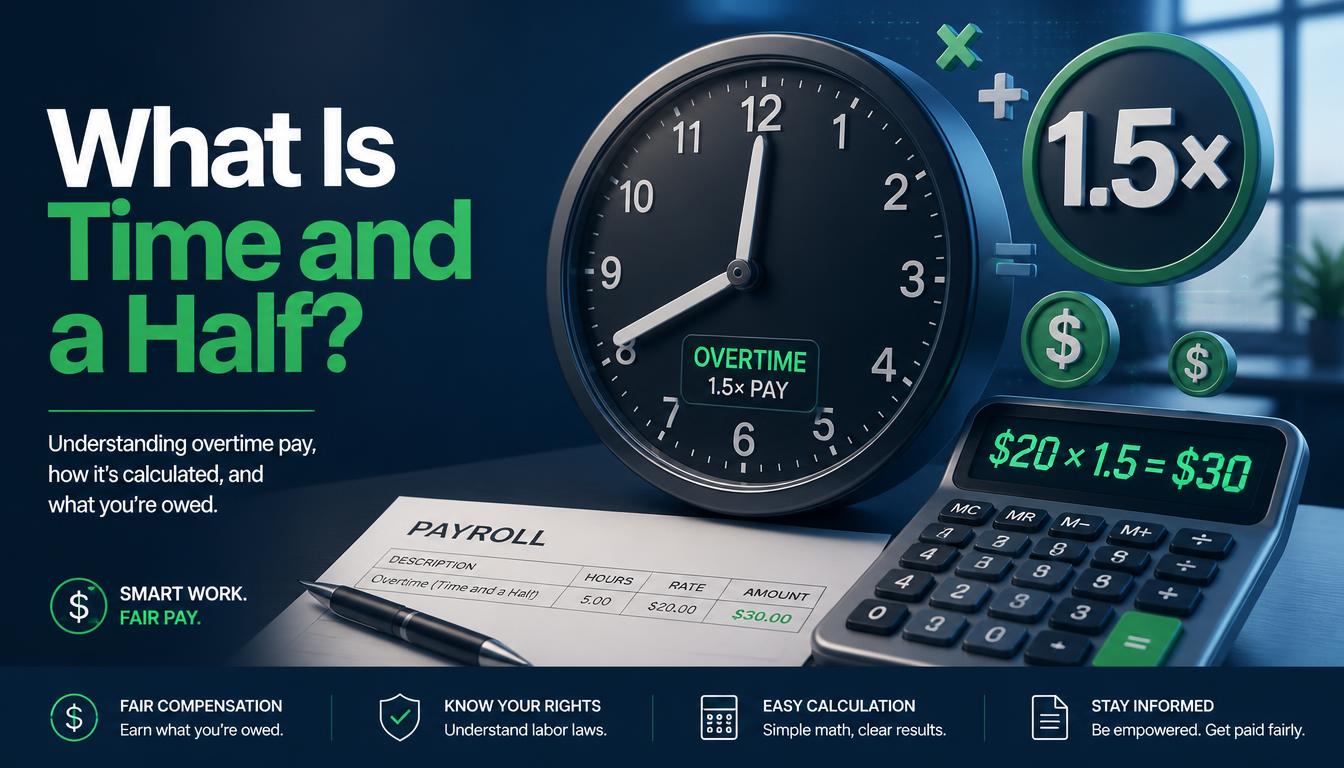
"Time and a half" is one of those phrases everyone's heard but not everyone can actually do the math on when it matters. It's simpler than it sounds: it just means one and a half times your normal hourly rate, paid for hours worked beyond a certain threshold — usually 40 hours in a workweek under federal law.
The name comes straight from the math. You get your regular pay ("time"), plus half of that again on top ("a half"). $20 an hour becomes $30 an hour. $16 becomes $24. That's it — no hidden complexity once you see the pattern.
The Formula
Time-and-a-Half Rate = Regular Hourly Rate × 1.5
Apply that rate only to the hours that actually qualify as overtime — for most people, that's hours worked beyond 40 in a single workweek. Hours under 40 still get paid at your normal rate.
Quick Reference: Common Hourly Rates
| Regular Rate | Time-and-a-Half Rate |
|---|---|
| $15.00/hr | $22.50/hr |
| $20.00/hr | $30.00/hr |
| $25.00/hr | $37.50/hr |
| $30.00/hr | $45.00/hr |
| $40.00/hr | $60.00/hr |
If your exact rate isn't on that list, the shortcut is easy to do in your head for round numbers: take half your hourly rate and add it back on. $18/hour → half is $9 → $18 + $9 = $27/hour on overtime.
How It Plays Out Over a Full Week
The rate is only half the picture — what actually matters is what it does to your total paycheck. Say you earn $25 an hour and work 48 hours in a week. Your first 40 hours are paid at $25, coming to $1,000. The remaining 8 hours are paid at $37.50 (time and a half), adding $300. Your total for the week is $1,300 — not $1,200, which is what you'd get if all 48 hours were paid flat. That $100 difference is the entire point of the overtime premium: it compensates you extra specifically for the hours beyond the standard threshold, not just more hours at the same old rate.
Is It Actually Required by Law?
For covered, nonexempt employees, yes — the federal Fair Labor Standards Act (FLSA) requires at least time and a half for hours worked beyond 40 in a workweek. "Nonexempt" is the key word: exempt employees, generally salaried workers who meet specific salary and duties tests, aren't covered by this requirement. Being paid hourly is a strong signal you're nonexempt, but salaried workers can be nonexempt too, depending on their actual role and pay level. We cover the exempt/nonexempt line in detail in Salaried vs Hourly Employees: Who Gets Overtime?
Time and a Half vs. Double Time
These get used interchangeably sometimes, but they're not the same thing. Time and a half is 1.5x your regular rate and is the federal minimum for overtime. Double time is 2x your regular rate — a genuinely higher premium that federal law doesn't require in most situations. Double time shows up when an employer voluntarily offers it, often for holidays, or when a specific state rule mandates it, like California's rule for hours worked beyond 12 in a single day.
Does Weekend or Holiday Work Automatically Trigger It?
No, and this trips a lot of people up. Federal overtime is based purely on total hours worked in the workweek, not which specific days those hours landed on. Working a Saturday shift doesn't earn time and a half by itself — it's simply added to your weekly hour count like any other day, and only becomes overtime once your total crosses 40. Same logic applies to holidays: there's no federal holiday-pay requirement. Any holiday premium you see on a paycheck is a policy choice your employer made, not a legal minimum.
Can Employers Pay More Than Time and a Half?
Absolutely — time and a half is a floor, not a ceiling. Nothing stops an employer from offering double time, a higher multiplier for specific shifts, or better terms than federal law requires. Some industries with hard-to-staff overnight or holiday shifts use a richer multiplier specifically as a recruiting tool.
State Laws Can Add More
Federal law sets the minimum, and states are free to require more, never less. California's daily overtime rule is the best-known example — generally requiring time and a half after 8 hours in a single day, on top of the standard weekly threshold. A handful of other states have their own variations, so it's worth a quick check of your specific state's labor law if you regularly work long single-day shifts, since the federal 40-hour-a-week rule might not be telling the whole story for your paycheck.
Time and a Half for Salaried Nonexempt Employees
Salaried doesn't mean automatically exempt. If a salaried employee is classified as nonexempt, they're still entitled to time and a half — the math just starts by converting the salary into an appropriate hourly or regular rate, which is more involved than dividing salary by a fixed number of hours. We walk through this conversion with real numbers in Salaried vs Hourly Employees: Who Gets Overtime?
How Taxes Affect Time-and-a-Half Pay
Time and a half pay is regular taxable income — there's no special "overtime tax rate." It can look more heavily taxed on a specific paycheck because of how employers withhold supplemental wages, but your actual tax liability is settled against your total annual income at filing time, same as any other pay. The full breakdown, including why your overtime check sometimes looks lighter than expected, is in Is Overtime Taxed More Than Regular Pay?
A Common Mistake
The most common slip-up is applying the 1.5x multiplier to all hours worked in a week, rather than just the hours beyond 40. Someone working 45 hours at $20/hour doesn't earn $20 × 1.5 × 45. They earn regular pay for the first 40 hours ($800) and time-and-a-half only on the remaining 5 ($150), for a total of $950 — not the larger number you'd get by applying the premium across the board.
Calculate It for Your Own Numbers
Rather than doing the split math by hand every time, our Overtime Pay Calculator takes your hourly rate, total hours, and threshold, and instantly shows the regular-pay and overtime-pay breakdown.
This article is for general information and isn't legal or tax advice. Overtime rules can vary by state and by your specific job classification.