
Salary & HR
When Does Overtime Start After 40 Hours?
By Anil Choudhary · Updated August 2026 · 7 min read
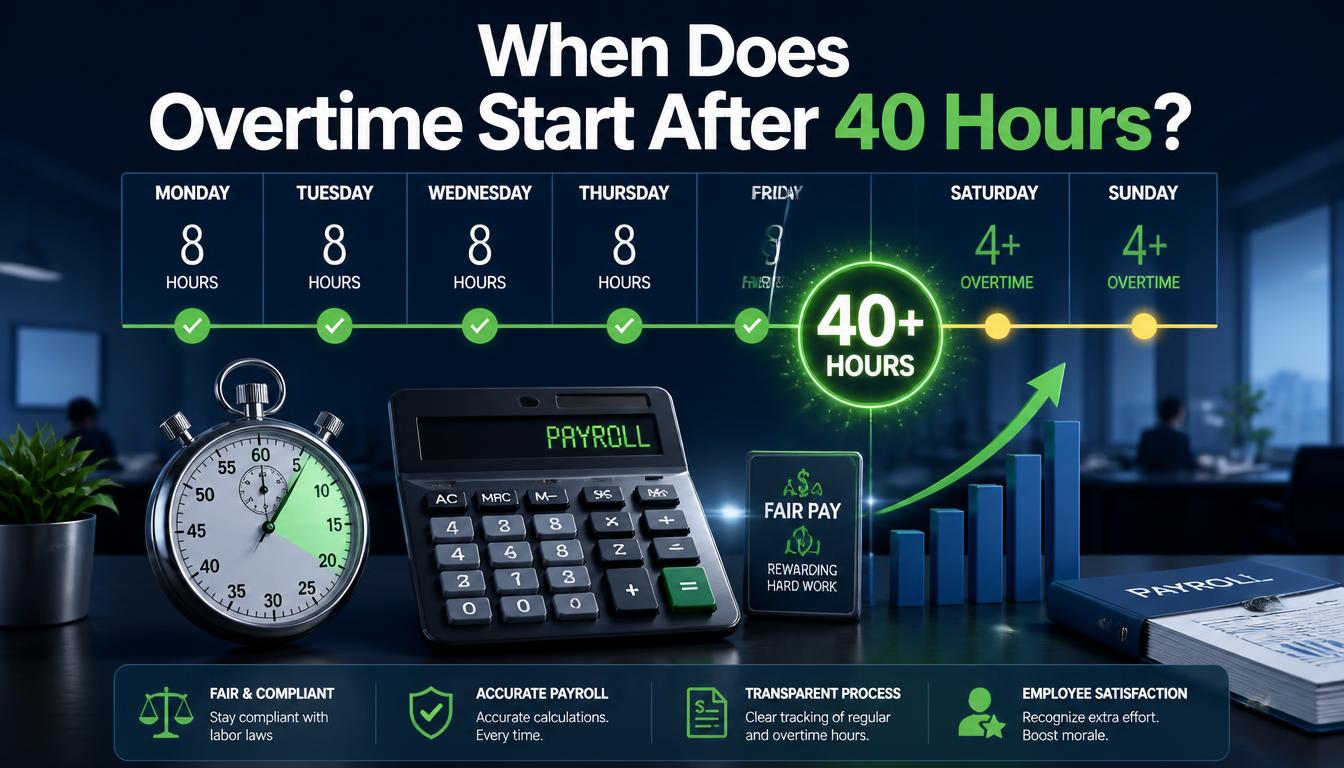
"After 40 hours" sounds precise, but people still get tripped up on exactly where the line sits — is it at 40, right after 40, averaged over the pay period, or something else? The federal answer is a clean one: overtime begins the moment your hours in a single workweek cross 40. Not at 40. Past it.
What "Workweek" Actually Means
Before the hour count matters, the time period it's measured against has to be defined. A workweek is a fixed, recurring 168-hour block (seven consecutive 24-hour days) that your employer sets — it doesn't have to run Monday through Sunday, and different departments at the same company can even use different workweeks, as long as each one stays fixed and isn't shifted around specifically to dodge overtime obligations.
Does Overtime Start at Exactly 40 Hours?
No. At 40 hours on the nose, you're still paid your regular rate for every one of those hours — nothing extra yet. Overtime applies only to hours beyond 40. That distinction matters because a fair number of people assume hitting 40 itself earns a premium, when really it's the threshold you have to cross, not land on.
Hour by Hour: What Changes as You Go Past 40
The table below shows regular vs. overtime hours at a few common weekly totals, assuming the standard 40-hour threshold.
| Total Hours | Regular Hours | Overtime Hours |
|---|---|---|
| 40 | 40 | 0 |
| 41 | 40 | 1 |
| 45 | 40 | 5 |
| 48 | 40 | 8 |
| 50 | 40 | 10 |
| 60 | 40 | 20 |
The regular-hours column never moves past 40 — it caps out there no matter how many total hours you work. Every hour beyond that is overtime, one for one. At 60 total hours, that's 20 hours of overtime, which at a typical 1.5x premium is a meaningfully larger chunk of the week's pay than the hour count alone might suggest.
Is It Calculated Daily or Weekly?
Under federal law, weekly. The FLSA doesn't care how your hours were distributed across the seven days of your workweek — only the total. Work 12 hours on Monday and 4 hours the rest of the week, and federal law treats that no differently than 6 hours evenly spread across six days, as long as the weekly total is the same. Several states diverge from this and add daily thresholds — California is the most prominent, generally requiring overtime after 8 hours in a single day regardless of the weekly total. If you're in a state with daily rules, that daily threshold can trigger overtime even in a week where your total stays under 40.
Does Your Pay Period Determine Overtime?
No, and this is one of the more common points of confusion. Your pay period — weekly, biweekly, semi-monthly, whatever it is — is just how often you receive a paycheck. It has no bearing on when overtime kicks in. A biweekly pay period actually contains two separate workweeks, and each one gets evaluated for overtime independently. Work 44 hours one week and 36 the next, and you're still owed 4 hours of overtime for the first week, even though the two weeks average out to a clean 40.
Does Weekend or Holiday Time Count Toward the 40?
Yes, in the sense that any hours actually worked count toward your weekly total regardless of which day they fall on — weekend hours aren't special or excluded. But working a weekend doesn't trigger overtime by itself; it's just added to the running weekly total like any other day, and only becomes overtime once that total crosses 40. Holidays work the same way for purposes of the 40-hour count, and there's no federal requirement for holiday premium pay layered on top.
Do Vacation or Sick Hours Count?
Generally, no. The 40-hour threshold is based on hours actually worked, not hours paid. If you take a paid sick day in a week where you also work 38 hours, your worked-hours total for the week is 38 — the sick day doesn't push you toward or past the overtime threshold, even though you were paid for it. Some employer policies choose to count certain paid leave toward overtime calculations voluntarily, so it's worth checking your specific company handbook if this comes up.
Can Employers Change the Workweek, or Require Overtime?
Employers can define or change their workweek, but not in a way that's specifically designed to avoid paying overtime that's already been earned. As for requiring overtime itself — in most jobs, yes, federal law doesn't cap how many hours a covered employee can be asked to work, and it doesn't give employees a general right to refuse overtime. It just requires that the overtime premium gets paid for the hours worked. Some states and specific industries (healthcare being a common one) do place additional limits on mandatory overtime, so it's not universal.
Common Mistakes About the 40-Hour Rule
The biggest one is assuming overtime is somehow averaged across a pay period rather than assessed week by week — it isn't. A close second is assuming vacation or sick time worked its way into the 40-hour count; generally it doesn't. And a fair number of people are surprised to learn that federal law is silent on daily overtime altogether, meaning a single 12-hour day in an otherwise light week doesn't trigger anything under federal rules unless your state says otherwise.
Work Out Your Own Hours
Rather than counting by hand, plug your actual weekly hours and rate into our Overtime Pay Calculator to see the regular-vs-overtime split and your total pay in one step.
This article is for general information and isn't legal advice. Overtime rules can vary by state and industry.